Thank you Marshall!  PS it seems obvious to me anyway that a tower built on landfill should have a foundation that goes down to bedrock. This and Millennium Tower show that you can’t cheap out on this.
1 Like
I get your point; it does ‘seem’ obvious. I can only paraphrase what a lawyer posted in the comments of this article I have posed below: “on what evidence are your stating that claim”.
The crux of the matter is the type of foundation used, which improves and firms the soggy soil, and then a thick concrete slab is put over the ‘improved’ soil. This may be prove to be an acceptable method for the foundation of this building. We do not KNOW if the tilt is due to a faulty foundation: that all needs to be determined by the subject matter experts in the field.
It is also claimed that at 3 inch tilt is not a matter for grave concern; as apparently there are other towers of similar height with the same (or greater tilt) and have been standing for years.
I only relate here what I have read on the subject; and will will all eventually learn more as the engineering studies and legal proceeding take place.
My two favorite nick names for this project - “faulty towers” or “the leaning tower of Pizzorotti”. 
1 Like
I love this guy -

3 Likes
That is a great preview of what we can expect with the future litigation and engineering investigations. We can only hope the One Seaport case can be settled and rectified within a shorter period of time: the SF tower case is going on for way too long.
One interesting ‘take away’ from that video: the exorbitant cost of the litigation was cleverly shifted to a law suit against the SF Power Authority; thus, much the litigation costs is taxpayer funded. I do not think that will be an option here with this case a One Seaport.
1 Like
This is another one that we might call ‘on hold’.
1 Like
Why can’t they simply apply glass to the exterior to make it appear as it’s done? At least that? Instead of leaving it as a concrete behemoth.
Money money money
1 Like
wasn’t this partly to reduce the load on the upper levels/prevent further leaning, or something?
1 Like
This is a bit off topic, but here is my conjecture after seeing flawed (great & small) construction happen all too often in America.
I think the root of the problem is the ‘design-bid-build’ industry wide practice; IPD or Design-Build is a better project delivery method IMHO.
There is much talk about reinvention the industry; this is a good read for those who want to do a deep dive on the subject.
1 Like
Nobody is going to add to a structure that is already unsound. There are liability issues.
1 Like
BY GREG B. SMITH [GSMITH@THECITY.NYC]
MAY 16, 2023, 5:00AM EDT
- [Facebook](https://www.facebook.com/dialog/share?app_id=252110943771470&display=popup&href=https%3A%2F%2Fwww.thecity.nyc%2Fmanhattan%2F2023%2F5%2F16%2F23724612%2Fstalled-condo-maiden-lane-fdny-hazard
- SHARE
- REPUBLISH
On a warm summer day last July, Fire Department inspectors entered a 58-story half-built skeleton of a tower in Lower Manhattan that was supposed to contain luxury condos with stunning views of New York harbor and all the high-end amenities affluent buyers expect.
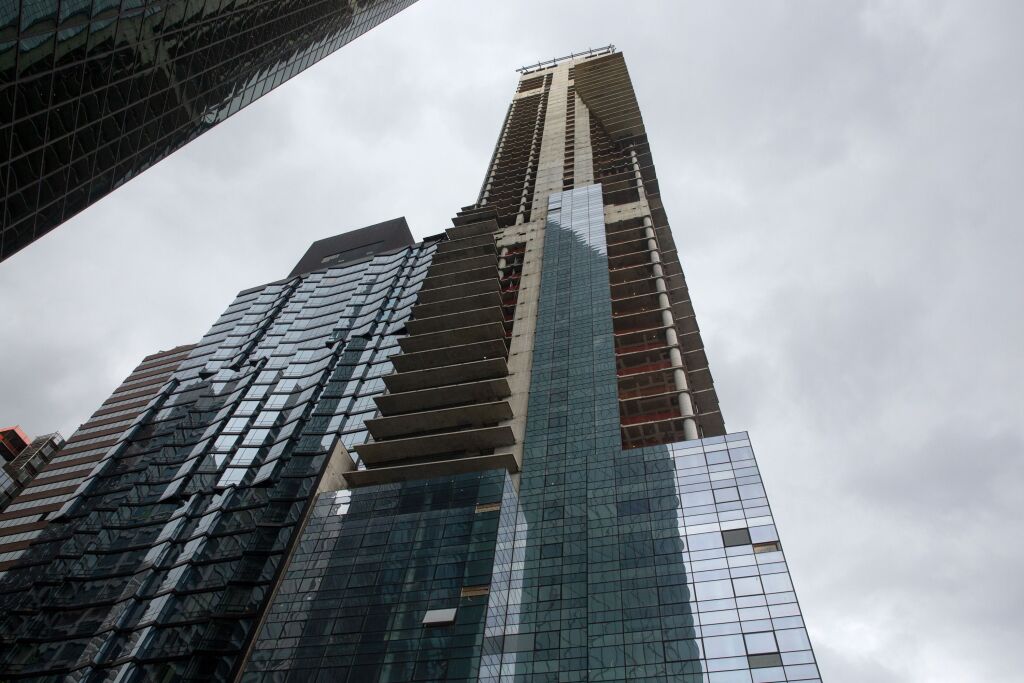
Instead, four years after it was first scheduled to open, the promised upscale high-rise remained an empty hulk, its upper floors open to the elements, most of its glass wall exterior yet to be installed.
This was 161 Maiden Lane — shut down by its owner midway through construction after the discovery that the entire structure leans slightly to the north.
What the fire inspectors discovered inside the so-called Leaning Tower of Lower Manhattan was alarming: a fire suppression system — a standpipe that provides firefighters with immediate access to water from top to bottom of the building — was not functioning.
Without a standpipe — which is essentially an extension of a fire hydrant — if a fire broke out on an upper floor in the abandoned structure, it would be extremely difficult to put it out. On top of that, inspectors discovered the required fire-watch employees were no longer on site to make sure no one could enter the building and potentially start a fire inside.
And according to a temporary receiver appointed by a court to manage the building while lawsuits continue over who’s to blame for the building’s tilt, 161 Maiden Lane had been without a working standpipe for more than a year when the FDNY showed up to inspect it.
Members and sponsors make THE CITY possible.
The receiver, Richard Cohn, told THE CITY that the problem with the standpipe began after a homeless person broke into the half-built structure sometime before he was sworn in as receiver in June 2021. Cohn said the person turned on the motor that powers the standpipe to generate heat, which broke the motor and disabled the standpipe.
Richard Bamberger, a spokesperson for the building’s owner, Fortis Building Group LLC, told THE CITY, “We are not aware of any problem with the standpipe when the receiver took over.”
But there was a significant gap in FDNY inspections, starting around the time the receiver began managing the building. While inspectors had found the standpipe functioning throughout 2020 and into May 2021 before Cohn showed up, they weren’t able to gain access to the building and check the standpipe for more than a year after that, according to FDNYspokesperson James Long.
And when they did in July 2022, they found the standpipe was out of order.
Fire Warning
The importance of a working standpipe on a high-rise building project became apparent to all of New York City in August 2007.
That’s when a non-functioning standpipe contributed to a disastrous fire in the upper floors of the empty Deutsche Bank tower, a 39-story building that had been damaged on Sept. 11 and was being demolished. Two firefighters died and 100 were injured after firefighters could not quickly get water up to the floors where the fire started.
The FDNY’s Long made clear the importance of a working standpipe in high-rise buildings: “If there’s an actual fire, you have to work that much harder to get hose lengths and ladders on the upper floors. You need that much more manpower. In that time, the fire can grow and expand.”
Given that history, on July 8, 2022, the FDNY declared 161 Maiden Lane to be a 670-foot-tall fire hazard, requesting an immediate inspection by the Department of Buildings regarding a “major building with no standpipe nor fire watch,” according to building department records.
The FDNY stated that the job site was “open and accessible to public … and no watch person on site as required.” DOB inspectors showed up and discovered all three gauges of the building’s standpipe were “zeroed out,” meaning there was “no pressure with the system” to bring water to the upper floors if necessary, records show.
Many floors at 161 Maiden Lane remain exposed.
Ben Fractenberg/THE CITY
DOB issued a Class 1 hazardous code violation deemed “aggravated offense level 1” for the standpipe and levied a $25,000 penalty. A second Class 1 hazardous violation for the missing-in-action fire watch person triggered a $2,500 fine.
Speaking with THE CITY, the receiver blamed delays in fixing the standpipe on a broken hoist inside the building that was needed to bring a replacement motor to an upper floor.
“The standpipe was compromised, but it needed materials to be installed because the hoist was not working,” said Cohn. “It’s been a tremendous effort to get things stable at the building.”
In mid-September, after the hoist was finally back in service, DOB inspectors determined that the standpipe had been restored and the fire watch employee was back on site.
“The situation has been resolved,” Cohn said.
Members and sponsors make THE CITY possible.
Records indicate that Fortis paid the fire watch fine, but the standpipe fine — which records state was issued to “Unavailable owner” — remained unpaid as of last week. No one affiliated with 161 Maiden Lane showed up at a Dec. 31 hearing before the city’s Office of Administrative Trials and Hearings (OATH) to resolve it. As a result, the penalty will likely be even higher than $25,000.
“The owners of a stalled work site have a legal responsibility to properly maintain the property in a safe condition,” DOB spokesperson Andrew Rudansky told THE CITY, noting that the department regularly visits 161 Maiden Lane to make sure the owners are complying with all applicable safety regulations. An April inspection found no violations and more checks are set for “the near future.”
Vertical Ghost Town
The useless standpipe was hardly the only safety issue at 161 Maiden Lane, an ambitious development that first went off the rails five years ago and now sits unfinished on the East River waterfront, a symbol of what can go wrong in the rush to make a profit off valuable Manhattan real estate.
Calamity struck the site even before work stopped there. In 2016, a 43-year-old laborer, Juan Chonillo, fell 29 stories to his death during the concrete pour. His employer, SSC High Rise Inc., pleaded guilty to manslaughter charges and paid $842,000 in restitution for failing to ensure the job site was safe
A review by THE CITY of emails, affidavits and building department records filed in connection with multiple pending lawsuits about who is to blame for the structure’s troubled state reveals that the building’s unexpected tilt has raised safety concerns that go beyond a non-functioning fire suppression system.
The saga began at ground level in 2014 with a geotechnical design firm hired by Fortis Building Group, RA Engineer LLP, that made recommendations about the massive building’s foundation.
RA first recommended driving piles deep into the Manhattan bedrock lying beneath the landfill deposited there starting in the 19th century, which makes up much of the East River’s shoreline. All of the buildings around 161 Maiden Lane relied on this pile-driving technique for support, and RA declared that building settlement and movement would be negligible with a pile-driven foundation.
But RA also offered Fortis a less expensive alternative: injecting chemicals into the soil to harden the fill. RA declared this method was “technically feasible,” with the caveat that the developer could expect two-inch settlement during construction, with an additional one inch once the building was complete and occupied. This is the method Fortis adopted.
Department of Buildings records indicate the agency received documents regarding a soil inspection in September 2014 and approved the foundation plan on Oct. 1, 2015.
But by summer 2019, Fortis publicly acknowledged that 161 Maiden Lane was now tilting to the north by three inches before the building was even finished.
Fortis’ architect, WSP USA, claimed this was a “manageable” degree. But Thornton Tomasetti, an engineering firm hired by the project’s construction manager, Pizzarotti LLC, asserted that the tilt was even worse than that, leaning by four inches even before the full weight of an occupied building was in place.
“The [settlement] values predicted have been exceeded already and the full dead load of the building has not yet been added and the building occupants have not yet moved in,” according to Elisabeth Malsch, a licensed engineer and senior principal at Tomasetti. “The ongoing movement of the top of the building long after top-out suggests that this long-term creep behavior is far more significant than the short-term movement that occurred during pauses in construction.
“Additional movement will occur as work progresses,” Malsch warned.
In its lawsuit, Fortis blamed Pizzarotti. As the architect, WSP USA insisted the chemical injection method was not an issue and instead charged that Pizzarotti did not properly oversee the concrete pour at the site and failed to maintain “plumbness,” or straighness, as the building rose upward. That, WSP contended, was the reason for the excessive tilt.
In its suit against Fortis, Pizzarotti placed the blame squarely on what it deemed to be the design flaw caused by the decision not to pile drive the foundation. (Both suits are pending.)
Pizzarotti’s lawsuit quoted an email by the project’s concrete subcontractor first noticing the tilt in April 2018, describing what he said was “unusual settlement” of the building. That June the subcontractor for the glass curtain wall that sheaths the building’s exterior discovered the building’s wall frame showed a two-inch difference to the north between the 11th and 21st floors.
‘Safety Remains a Concern’
By 2019, all work had stopped at the site. In an affidavit recommending that work should not resume until the project could be redesigned, Malsch of Thornton Tomasetti warned of dangerous conditions if work continued without a design revamp.
“Safety remains a concern with respect to future work, particularly the installation of the [glass] curtain wall,” she stated. “There is insufficient information to assure that the building will remain safe if work advances because the building continues to settle and there is no evidence that the curtain wall has been properly re-designed to take the movement into account.”
The degree of lean could also result in “breaking windows and components falling to the street,” which could “fall from a height of up to 58 stories down to the street below, causing grave injury to persons and property,” Malsch stated.
Despite the discovery of the tilt, construction continued, with the building topping out in fall 2018. When Pizzarotti sued Fortis in spring 2019, they notified Fortis that work could not proceed until the building was redesigned.
Since then the building has remained a vertical ghost town. Most of the upper floors remain open to the elements, and the billboard attached to the sidewalk shed that advertises a summer 2021 opening is now scarred with graffiti.
4 Likes
2 Likes
Unsound and now a “fire trap” too. These construction fiascos occur all too often; it boggles the mind. This building may need to be completely deconstructed.
It at least has been an interesting topic of discussion on this forum. 
Quote from above article -
What the fire inspectors discovered inside the so-called Leaning Tower of Lower Manhattan was alarming: a fire suppression system — a standpipe that provides firefighters with immediate access to water from top to bottom of the building — was not functioning.
Without a standpipe — which is essentially an extension of a fire hydrant — if a fire broke out on an upper floor in the abandoned structure, it would be extremely difficult to put it out. On top of that, inspectors discovered the required fire-watch employees were no longer on site to make sure no one could enter the building and potentially start a fire inside.
1 Like
Fortis (and Pizzarotti) messed up, but the city deserves some blame. A block as absurdly small and close to the river as this and regulations allow two extremely narrow highrises (the smaller hotel and 1SP) built at nearly the same time and no room for staging. There should be special regulations for foundations within 100’ of a body of water.
This is probably more difficult to fix than Millenium Tower and I agree demo is likely the next step here. It will be the second tallest building ever voluntarily demoed after Union Carbide (35’ taller); 1SP is 60’ taller than the Singer building was.
4 Likes
Interesting that chatter is returning about demolishing this one. The issue was raised quite a while ago on this page and most thought that was unlikely. But it looks more and more likely that the building won’t survive. Where the money will come from to take it down is anyone’s guess.
1 Like
This post looks informative.
The ‘tilt’ is clearly due to a lack of compression in the “compression only spring” combined with excess tension in the “tension only springs” - mystery solved… 
Just kidding here, for those who did not get the sarcasm!
My guess is they will demolish it to a certain point, maybe 40 floors, where it will be more manageable to fix the foundation. This is what they suggested for Millennium Tower.
4 Likes
That sounds about right on the how; but the question now is when. I think it will be years in litigation, then more years before any actual work, then a few more years to complete the ‘deconstruct’ process.
Time will tell - lots, and lots of time… 
1 Like